
§ Travel Guide
The Photography Guides That Became Legendary
Notes from the road — light, logistics, and the quiet discipline of seeing.
§ The Practice
Everyone is talking about them. Many would love to own one. But our guides are not for sale.
It is not for sale. It cannot be ordered. There is no generic edition. The only way to receive one is to join the journey.
Each of our photographic guides is devoted to a single workshop and belongs exclusively to the one photographer for whom it was created. Every detail is individually tailored—both to the experience itself and to the person who has chosen to live it.
Does this mean that our guides are truly unique, each one different from the next, created for the individual photographer who receives it?
Yes. That is exactly what it means.
The hour before the light arrives — Merzouga, Morocco
Our legendary photography guides. They cannot be bought. They are received by setting forth. For some time now, a question has circulated among photographers: “Where can I find one of your guides?” The answer is always the same: they are not found in bookshops, they cannot be ordered online, they cannot be downloaded. They are not for sale.
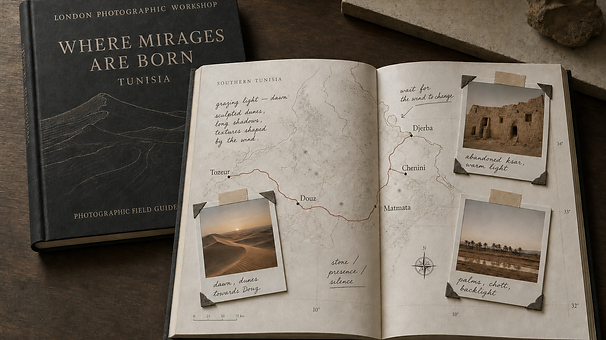
Each guide is made exclusively for a specific London Photographic Workshop and given only to the photographers who take part in that journey. Many long for a copy. Some have turned the pages held by those who returned from Iceland, Tunisia, Venice, Cappadocia or the Scottish Highlands. They have seen leaves dense with annotations, maps marked in pencil, hours of light underlined, thoughts written during a pause, photographs imagined before they were ever made.
And perhaps this is how it all began. Not with an advertising campaign, but with the quiet passage of an object from one photographer to another. With someone who, after turning its pages, asked: “May I have one too?”
§ A different guide for every journey
A different guide for every journey
Ours are not travel guides adapted for photography. They do not simply gather monuments, coordinates or places to reach. They do not suggest a sequence of already-seen images, to be reproduced one after another. And they do not turn the landscape into a list of viewpoints.
Each guide is born from a deeper question: what can a photographer recount while crossing this territory? To answer it we study the geography, the history, the light, the distances, the seasons and the character of places. We observe the way the landscape changes through the day, how people inhabit it, what traces time has left upon the architecture, the roads, the land and the memory.
Each workshop therefore possesses its own guide. The guide devoted to the desert cannot be the one for the northern islands. The one conceived for Venice could not accompany a journey through Cappadocia. Every territory demands a different language, rhythm, cartography and sensibility. For this reason there is no generic London Photographic Workshop guide. There is only the guide of the journey you have chosen.
§ Months of work bound between two covers
Months of work bound between two covers
Before a guide is delivered, there is a long labour the participant never sees. The territory is studied as one studies the subject of a photographic project. We do not merely seek what to show, but what is worth observing, in which moment, from which distance, and with what awareness.
We analyse the route, the position of the sun, the qualities of light, the hours of passage, the narrative possibilities and the alternatives offered by the weather. We set the landscape in relation with history, the architecture with human presence, matter with time.
Each chapter is written with what will truly happen in the field in mind. The guide anticipates the journey, but does not imprison it. It offers a structure without imposing a photograph. It indicates possibilities, not formulas. It helps one to prepare, observe and understand, leaving each participant free to find their own image. It is here that an essential part of our work is concentrated: transforming a destination into a coherent photographic experience.
§ An atlas of light
An atlas of light
Each guide is built as a small photographic atlas of the territory. Within it one encounters different layers of reading: the visual and cultural identity of the destination; the narrative structure of the workshop; the places we shall cross and the photographic reasons for which they were chosen; the character of light across the hours of the day; the relations between landscape, architecture, memory and human presence.
The indications needed to prepare the work in the field; the photographic exercises conceived for each phase of the journey; the questions that may help one move beyond the immediate image; the spaces set aside for notes, intuitions and the first sequences; the criteria that will guide the final selection and editing of the photographs.
It is not a technical manual, nor a catalogue of images to imitate. It is an instrument of visual orientation. A compass that indicates not only where to go, but invites one to understand why to stop.
§ Maps drawn for those who photograph
Maps drawn for those who photograph
The maps contained in our guides do not simply serve to link one stop to the next. They are designed to make the relationship between places legible: the distance between a village and the landscape surrounding it, the orientation of a valley, the opening of a coast, the passage from city to silence, from stone cultivated by man to the original matter of the territory.
A map for photographers must help one imagine the movement of light, the time needed to observe, and the visual relation between elements. It must remind us that reaching a place does not yet mean having seen it.
For this reason our guides protect the time of photography. They do not invite one to collect destinations, but to linger. To return. To recognise when the light changes and when a scene begins slowly to reveal its own meaning.
§ Technique in the service of vision
Technique in the service of vision
Technical aspects also find their place within the guides, but always in service of the account. We speak of exposure, depth, movement, composition, the choice of lens and the relation with light when these elements help us understand what stands before us. There is no universal recipe: each territory poses different problems and offers different possibilities.
In the desert, light can reduce the landscape to sign, rhythm and matter. In the northern regions, the sky can become the dominant part of the image. In an historic city, photography must learn to move among stratifications, presences and silences.
In villages and inhabited places, the responsibility of the gaze comes into play: how to approach, how to ask, how to respect, how to recount without appropriating the lives of others. The guide accompanies this passage too. From mastery of the instrument to the awareness of the author.
§ It does not tell you which photograph to make
It does not tell you which photograph to make
This is perhaps the most important difference. Our guides do not promise to lead you to the exact point where someone else has already made a celebrated photograph. They do not ask you to place the tripod in the same spot, at the same hour, to obtain a personal version of an already existing image.
Instead they help you read the territory. To recognise a relation between two figures. To observe how the wind alters a surface. To grasp the weight of a shadow. To see a road not merely as a passage, but as a narrative line. To distinguish a beautiful photograph from a necessary one.
The guide prepares the gaze so that, when something happens, the photographer is truly present.
§ An object born to be used
An object born to be used
The quality of a guide is not measured only in the moment it is delivered. It is measured afterwards. When the pages have been opened dozens of times. When a map bears the trace of a route. When a phrase written at dawn appears in the margin. When between two pages there remains the dust of a road, a grain of sand, or the memory of a day of rain.
Our guides are not meant to remain perfect. They are meant to live alongside the photographer. Editorial care, the choice of images, the clarity of the maps, the balance of typographic composition and the quality of printing all converge to create a beautiful object, but its true completeness arrives only during the journey.
At departure, all the copies seem alike. On return, no two identical ones remain. Each holds the traces of an experience, the decisions of an author and the beginning of a personal photographic account.
§ Why have they become a legend?
Why have they become a legend?
Perhaps because they are rare, yet they were not created to be rare. They are rare because each belongs to a place, to a workshop and to a precise group of photographers. Perhaps because they are beautiful, yet they were not created only to be admired. They are beautiful because we believe that form, materials and editorial care are part of the photographic experience.
Perhaps because they cannot be bought. But their exclusivity is not born of an artificial strategy. It is born of the fact that a guide finds its meaning only when it is used upon the territory for which it was conceived. A copy in the hands of one who has not lived the journey would be an incomplete object.
It is the workshop that transforms it. It is the hours in the field, the conversations, the waits, the missed photographs and those finally made that fill the space between the words. It is the participant who renders it unique.
§ One guide. One journey. One story possible: yours.
One guide. One journey. One story possible: yours.
At the end of the workshop, the guide does not cease to be useful. It becomes the first chapter of the project. It accompanies the selection of the images, helps one remember the intention with which they were made, and preserves the narrative thread of the journey.
It may return to the desk during editing, reappear beside the proof prints, or be reopened years later, when a photograph finally reveals a meaning we had not yet recognised in the moment. This is why whoever possesses one rarely parts with it.
And this is why, when someone else sees it, they inevitably ask where they might find it. The answer will continue to be the same: the photography guides of London Photographic Workshop cannot be bought. They are received by choosing a journey. They are completed by living it.
“The journey begins on the page. The story begins in the field.”
§ What Each Guide Contains
A Volume, Not a Pamphlet
- §A light map — the hours, directions, and qualities of light that define the destination across seasons.
- §A gear brief — what to carry, what to leave, and why; calibrated to the climate and the kind of image you are after.
- §A logistics primer — where to stay, how to move, and the small practical truths that save a day in the field.
- §A set of field exercises — structured ways of seeing that turn a visit into a practice.
- §A reading of the place — the cultural and visual character that separates a photograph of a place from a photograph in a place.
We add to this ledger as the road gives us reason to.
Some guides are born from a single expedition; others accumulate across years of return.
None of them are finished — a place is never finished — and that is the point.
Carry them lightly, read them slowly, and let the light do the rest.